Feel free to check out more my
GithubThis page shows a few non-game projects and neat code snippets, which are part of unreleased games.
2D GI Game Engine
2026

Made using Vulkan

2 Team Members

1 Month
Graphics Programming
Raymarching
Radiance Cascades
Global Illumination
Game Engine
Read More
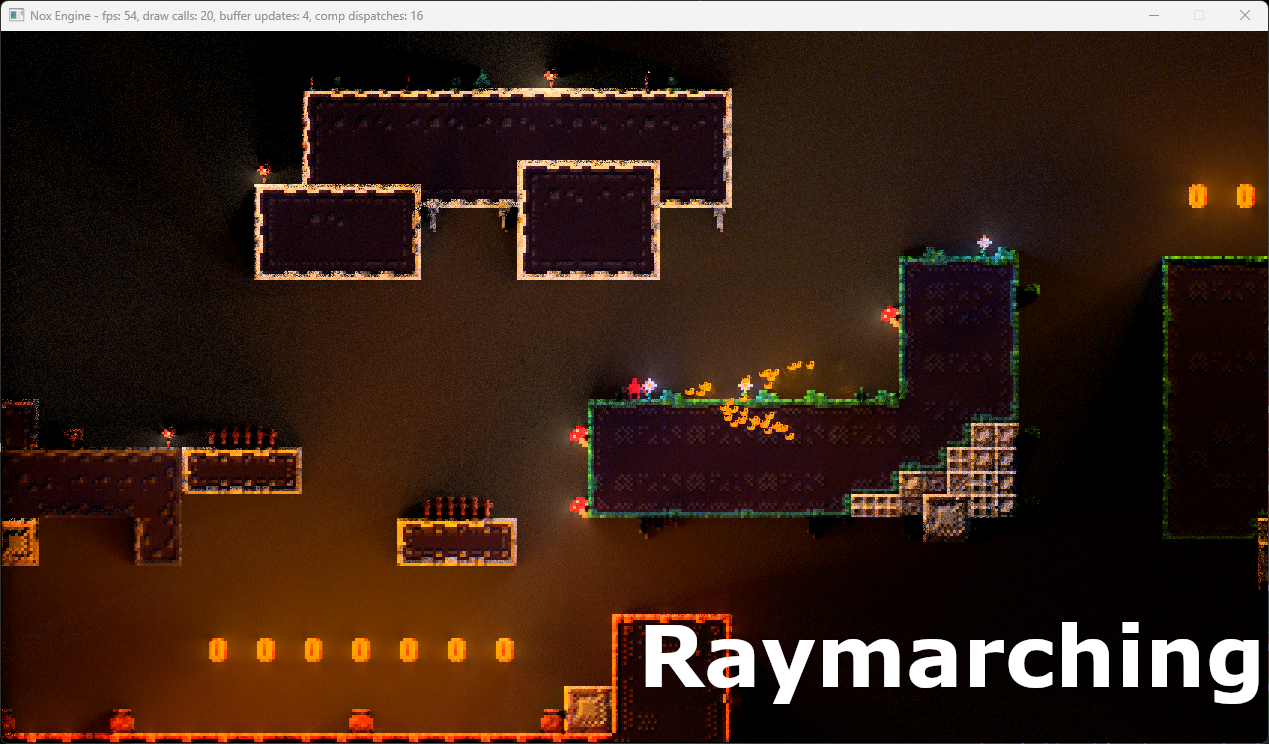
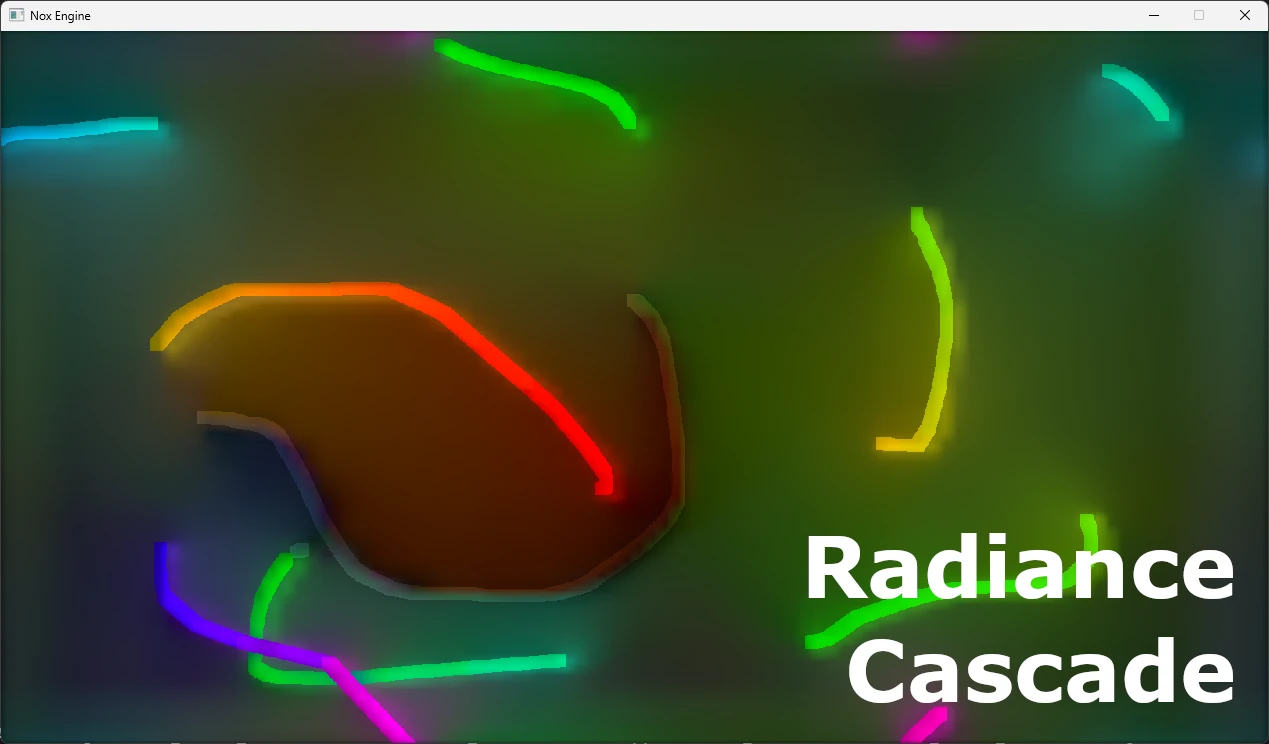
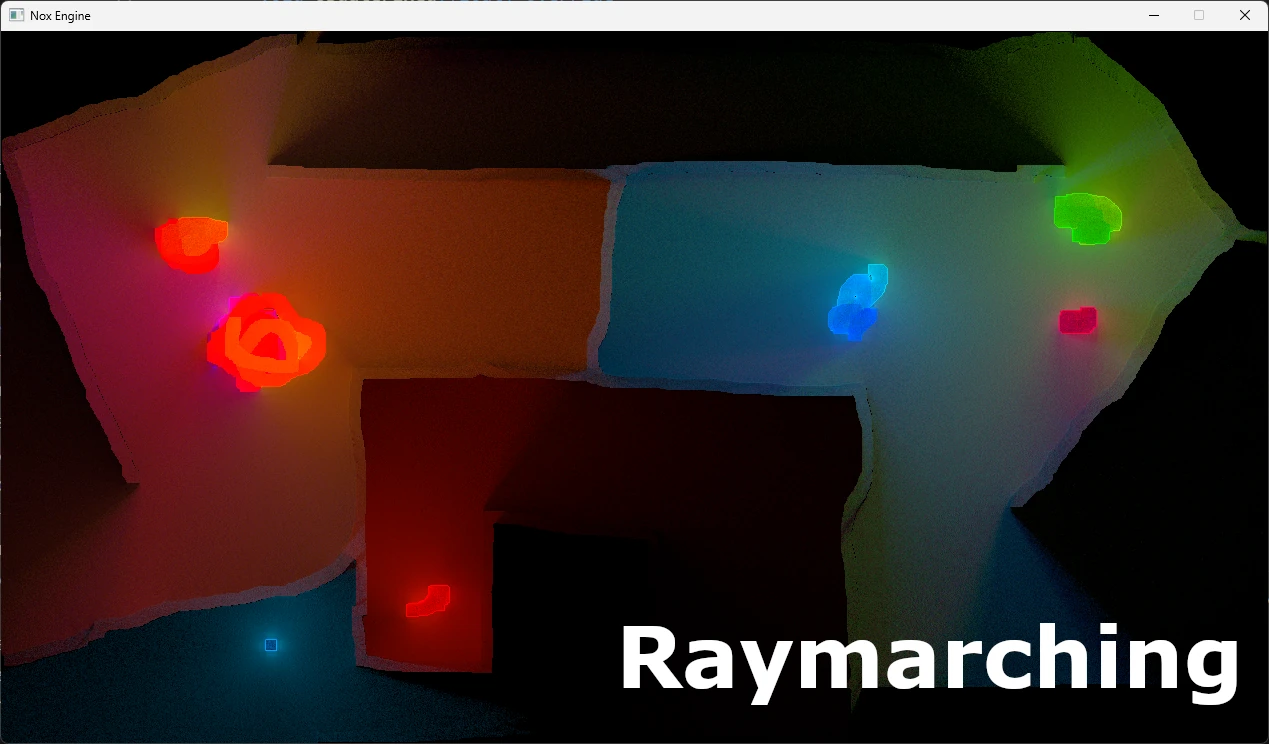
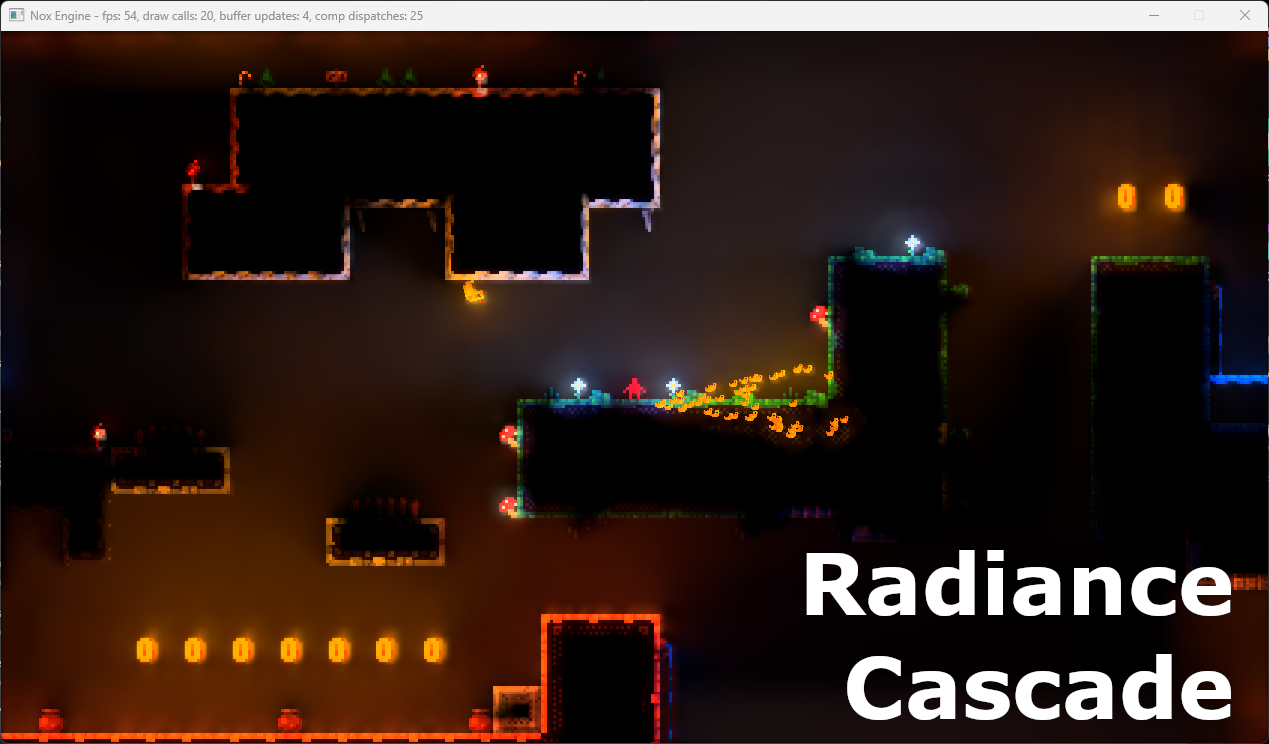
The Nox Game Engine is a 2D engine with Global Illumination using Radiance Cascades.
The engine is fairly complete, including scene & resource management, GameObjects and multiple demos.
My contribution was mostly in the rendering, specifically the lighting. On a modern computer, the engine calculates full global illumination in screen space at up to 100 fps.
The lighting consists of the following stages:
- GameObject Registration
- Transfer Stage
- Data Packing
- Automatic Buffer Updates
- G-Buffer (Deferred)
- Batched & Culled Tilemap
- Instanced Sprites
- Light Preparation
- Jump Flood Algorithm
- SDF Creation
- Build Cascades
- Light Composition
- Merge Cascades
- Tonemapping
Click on Screenshot to view
Pathtracer
2025
Made using Vulkan
2 Team Members
1 Week
Graphics Programming
Pathtracing
Physically Based
Hardware Accelerated
Read More
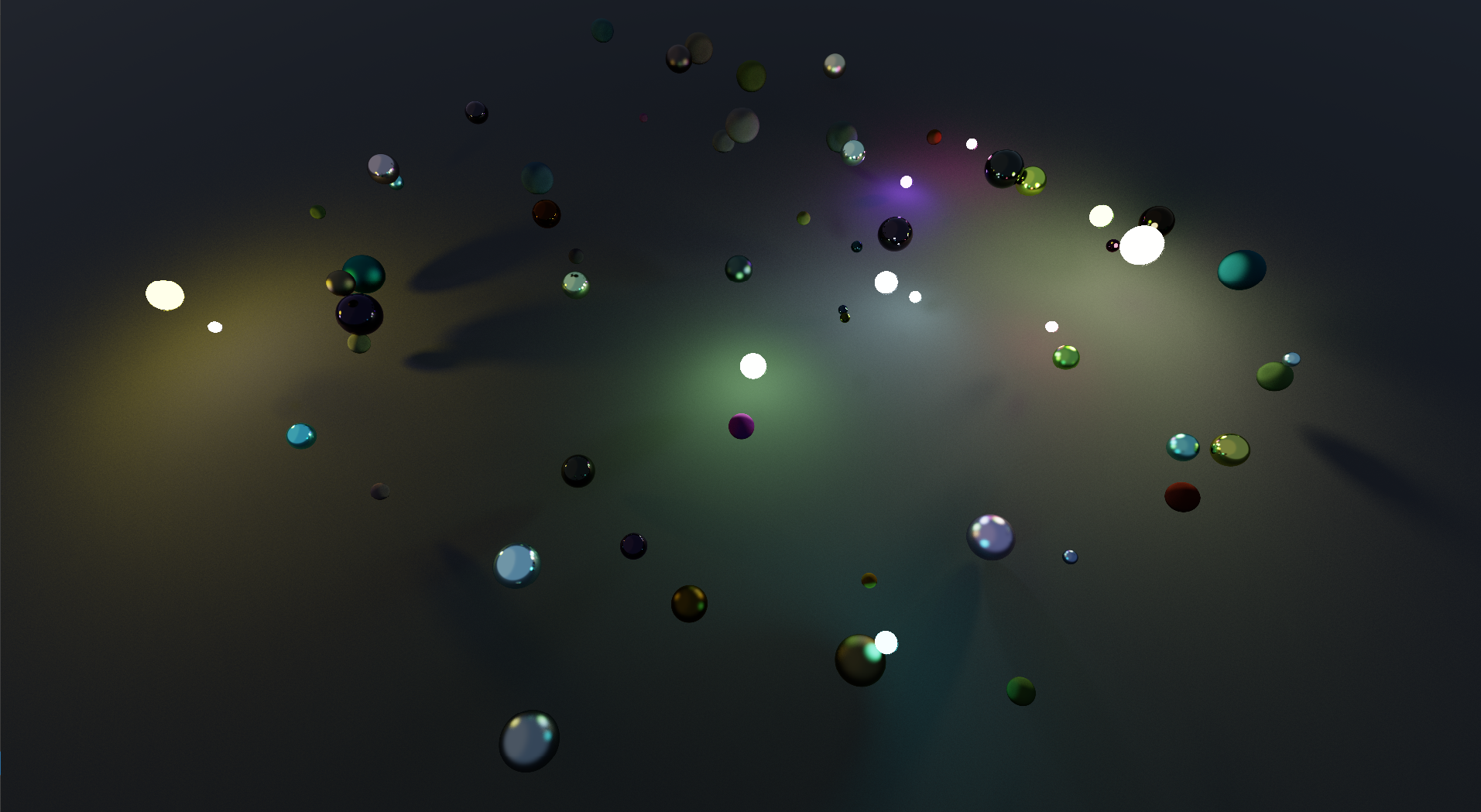
A PBR Pathtracer (on the GPU, supporting Vulkan ray tracing extensions). The goal of the project was to deepen my understanding of physically-based rendering. Even though this is a team project, I was entirely responsible for the lighting calculations.
It supports:- Sphere Intersection
- Plane Intersection
- Torrance-Sparrow BRDF
- Importance Sampling
- Sky-Radiance
- Temporal Denoising
Click on Screenshot to view
Volume Pathfinding
2025

Made using Unity

Solo Development
Weekend Project
Pathfinding
Multi-Threading
Tool Dev
Enemy AI
Read More
Volume Creation
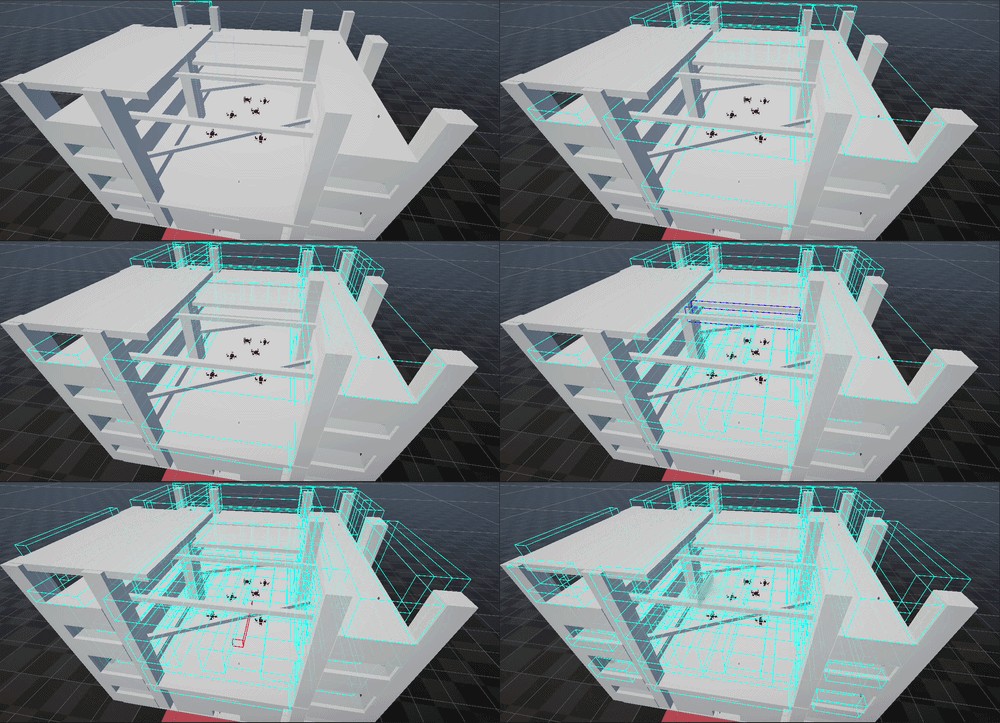
The first task is to analyze and annotate the scene's navigable areas. The naive approach of scene voxelization serves as a good starting point, but scales badly with large scenes. To mitigate this, I combine adjacent voxels into larger AABB Volumes, in a process similar to greedy meshing. This results in a volume count reduction of 90%, bringing a massive performance improvement. Afterwards the volumes are tested for intersections and the adjacency matrix is filled accordingly.
Pathfinding
The pathfinding itself follows a rather tried-and-tested approach. Each navigation agent supplies requests to a navigation manager, which then buffers and hands them off to a worker thread. On completion, it invokes callbacks with the resulting path. The chosen algorithm is the commonly used A*. I paid special attention to minimizing garbage collection overhead. All data containers are allocated once at the beginning and then only cleared, not destroyed, for each request.
Click on Screenshot to view
Stylized Rendering
2024
Made using Unity
Solo Development
Weekend Project
Post-Processing
Compute Shader
Tool Dev
Texture Filtering
Read More
Post-Processing
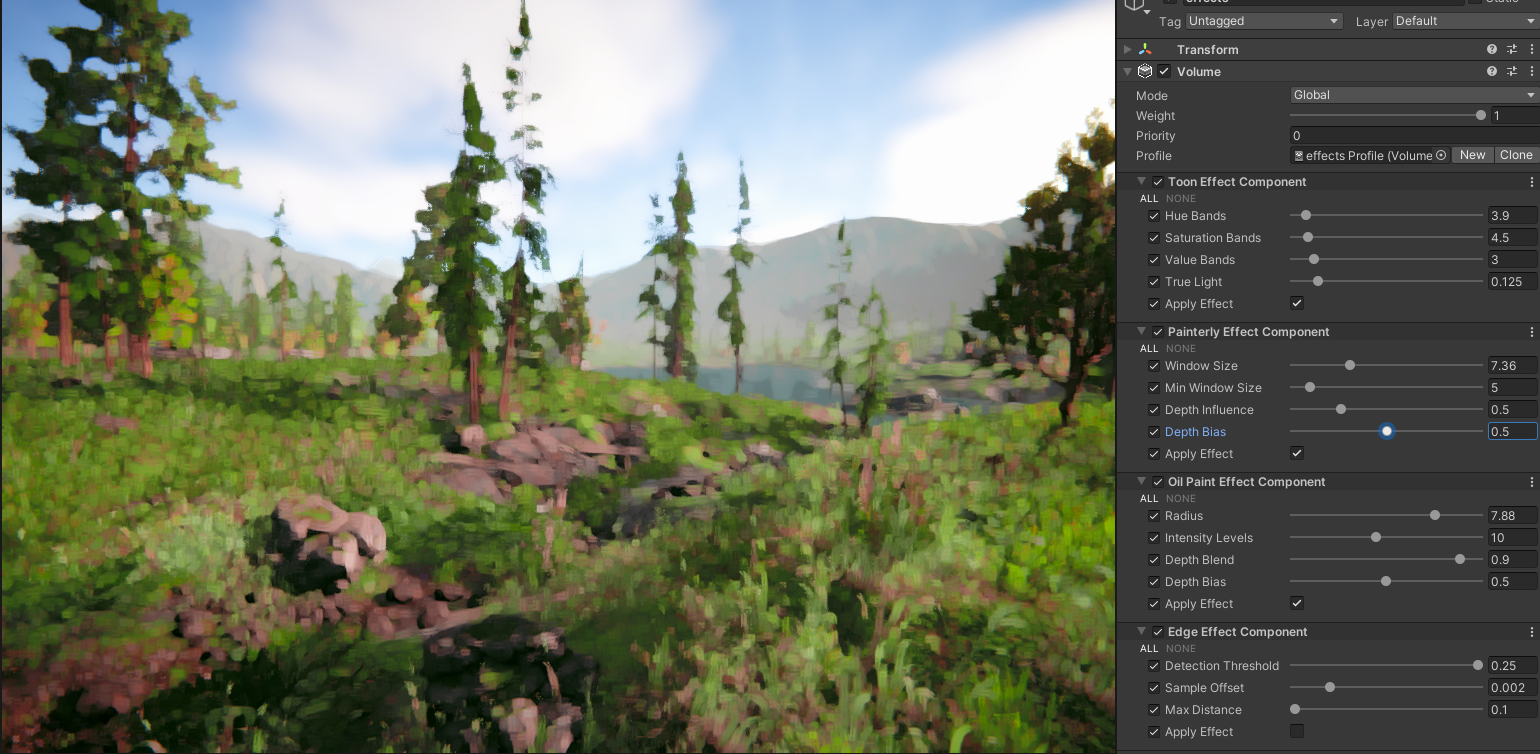
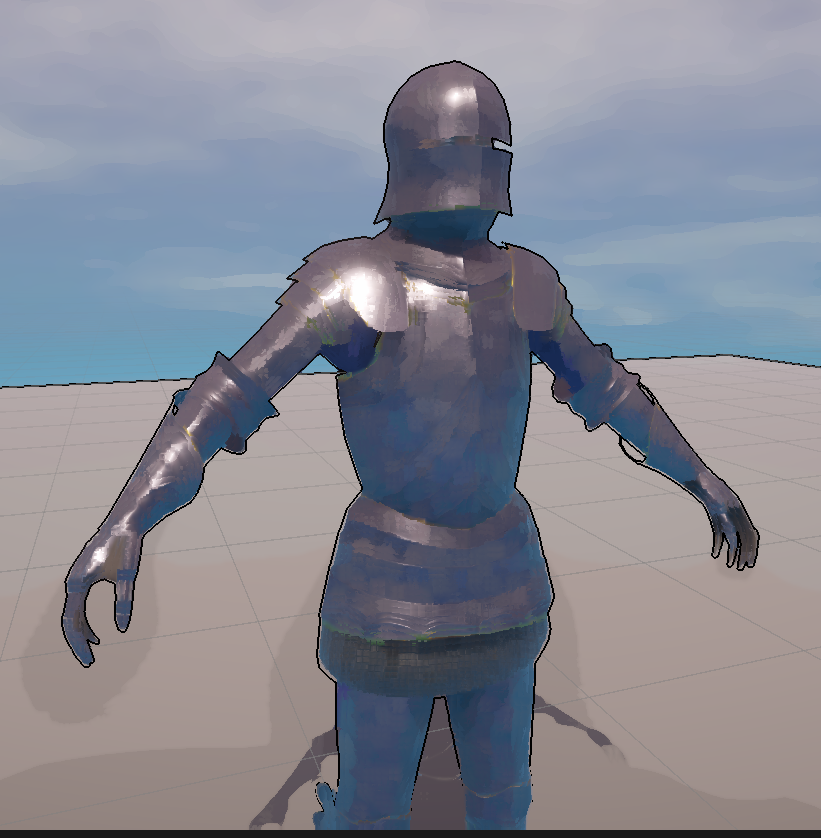
I created multiple shaders and integrated them into Unity's existing Volume-based Post-Processing Stack. This way, the effects can be used and tuned using the workflow artists are already familiar with. When combined, the effects turn any game into a painting, though with a noticeable performance impact.
Implemented Effects:
- Cell Shading
- Kuwahara Filter
- Oil Paint Filter
- Outline
Texture Filtering
In the area of artistic stylization, another interesting approach has recently become popular:
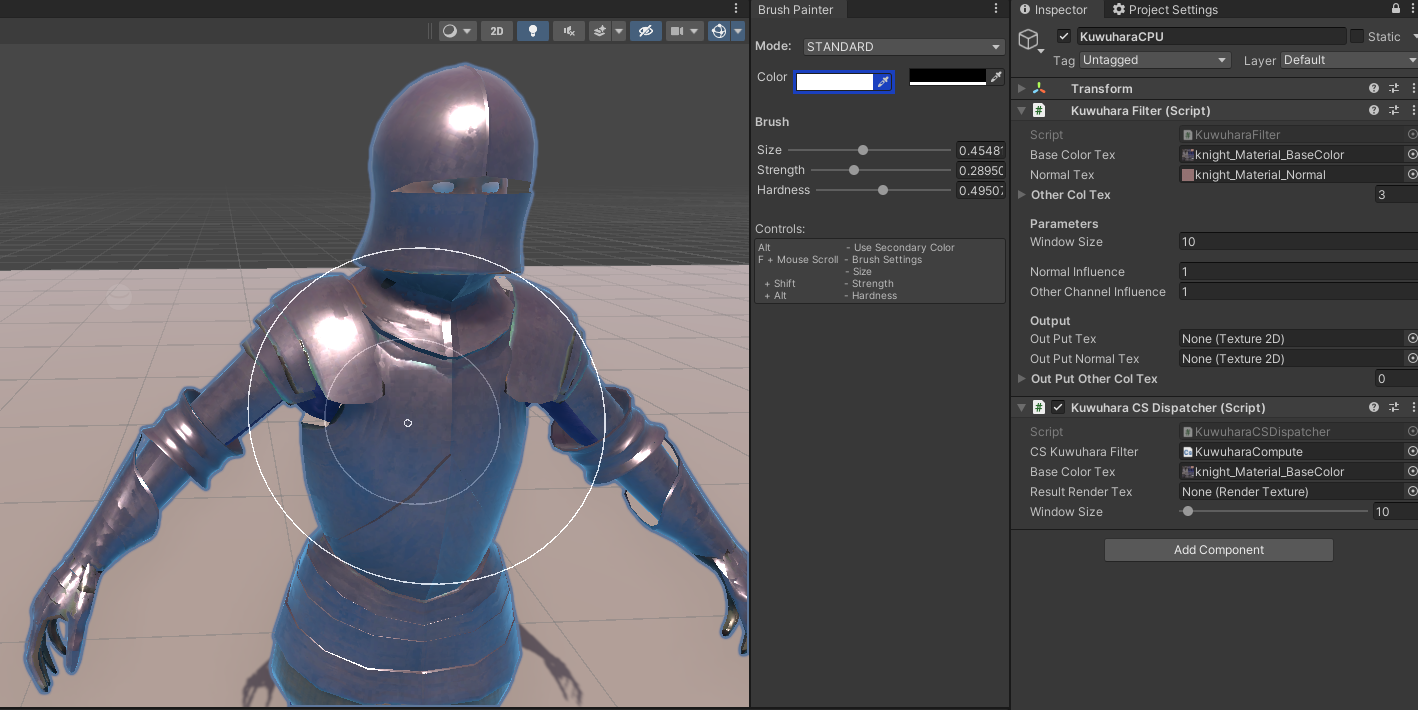
Applying brush strokes to the normal map, in order to create areas of solid light in the final render.
This off-loads the effort from the game engine entirely onto the arists. It is usually a laborious process,
where all textures of a material have to be modified identically, in order to create a convincing effect.
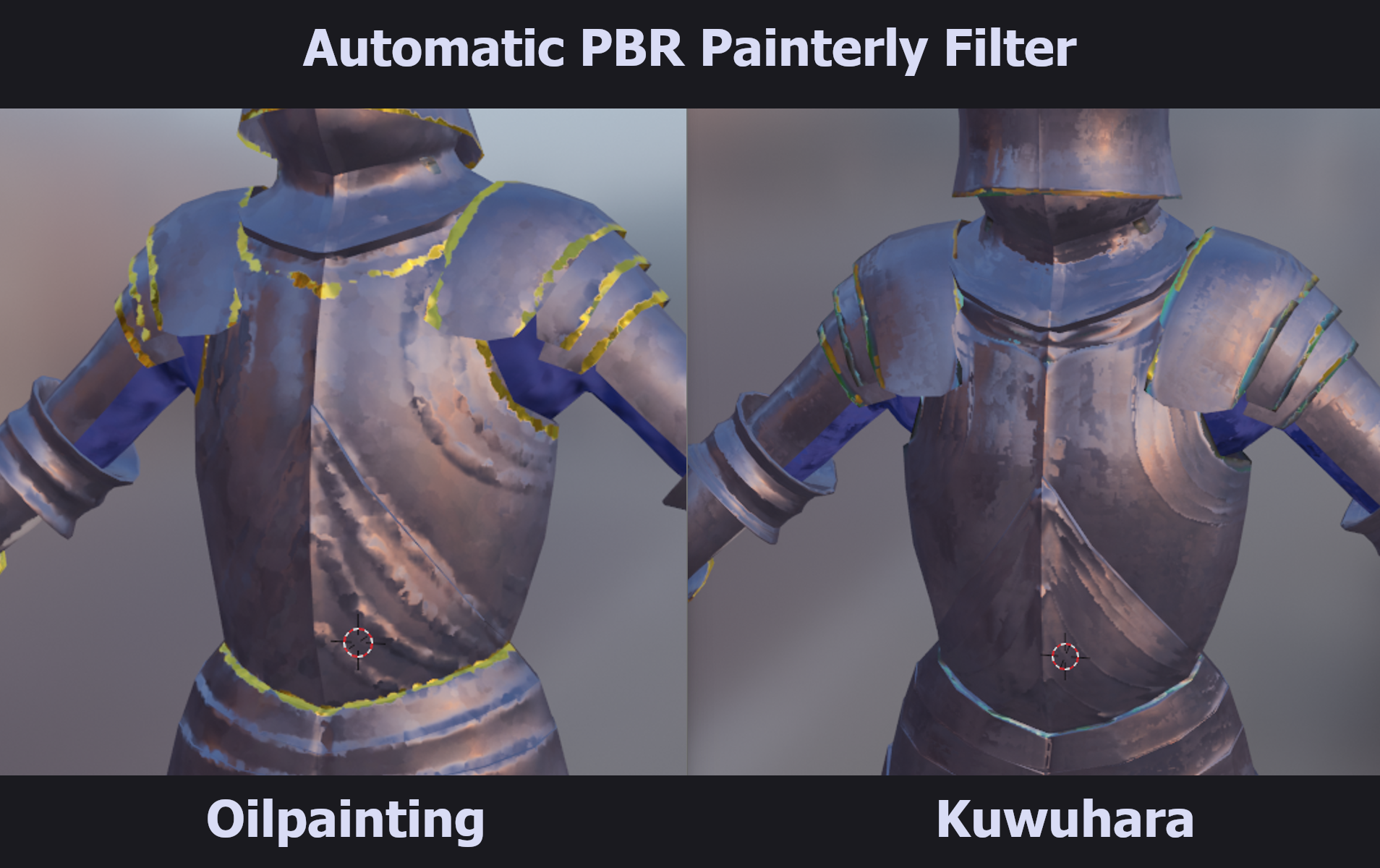
I automated this, by extending the classical Kuwahara filter,
to accept multiple textures as input. When calculating the variance inside a quadrant,
I take all the textures into account and then choose the same quadrant for all textures.
This way, all the textures of the material have identical brush strokes, generated using a compute shader at the click of a button.
Admittedly automated image filtering cannot match manual artistic intent, but it serves as a great starting point to be refined by an artist.
The tool is not meant to stand on its own, but to be a part of a larger workflow, to be a time saver.
Click on Screenshot to view
Light Probe Placer Editor Tool
2023
Made using Unity
Solo Development

Available on Github
Weekend Project
View on Github
Tool Dev
Editor
Level Design
Lighting
Read More
Placing each light probe of a group by hand is tedious and boring.
This tool automatically places them in a grid pattern, within a box, optionally avoiding intersections with scene geometry.
This tool doesn't do much, but it helps speed up my workflow significantly. The current script is available on Github.
This Portfolio Website
2023
Solo Development
Available on Github
Ongoing Project
Portfolio
Blog
Website
Web Dev
UI/UX
Read More
Its main purpose is to showcase my projects and display my resume, whithout any fancy design shenanigans getting in the way. That said, I still aimed for a modern style.
The current script is available on Github.
HOSAS Input Management
2023
Made using Unity
Solo Development
Available on Github
Weekend Project
View on Github
Input
Joystick
HOSAS
Fligh Sim
T16000M
Read More
By default, Unity does not recognize the difference between left- and right handed flight sticks. There is however, a suitable system for XR-Controllers in the form of Configuration Usage Tags.
These scripts automatically assign a side to Thrustmaster T16000M sticks by reading the value of the little switch on the bottom.
Additionally, the sides get updated automatically at runtime, should the switch be flipped again - or another device be plugged in.
The current script is available on Github.
Granular Audio Synthesis
2022
Made using Unity
Solo Development
Available on Github
Weekend Project
View on Github
Audio Programming
Granular Synthesis
Signal Processing
C#
Read More
More specifically, it makes use of granulation of sampled sound. The script doesn't speed up or pitch shift the input sound, but traverses it based on engine RPM.
It separates an input sound into smaller sections called grains and adjusts them to avoid clipping. During runtime it chooses a grain, which resembles the desired RPM of the virtual engine. To make the granulation less noticeable, grains are cross-faded (through so-called envelopes) and some variation (in the form of slightly randomized RPM) is added.
There are lots of opportunities for improvement, as this is just a small experiment. Specifically I'm looking into Dave Stevenson's comprehensive explanation of adjusting grain boundaries based on analysis of the frequency space.
The current script is available on Github
SusOp
2021
2 Team Members
Available on Github
Weekend Hackathon

View on Github
Network Monitor
Sustainability
power consumption
Java Swing
UI/UX
Read More
is a project I made with a friend for the hackaTUM 2021 hackathon.
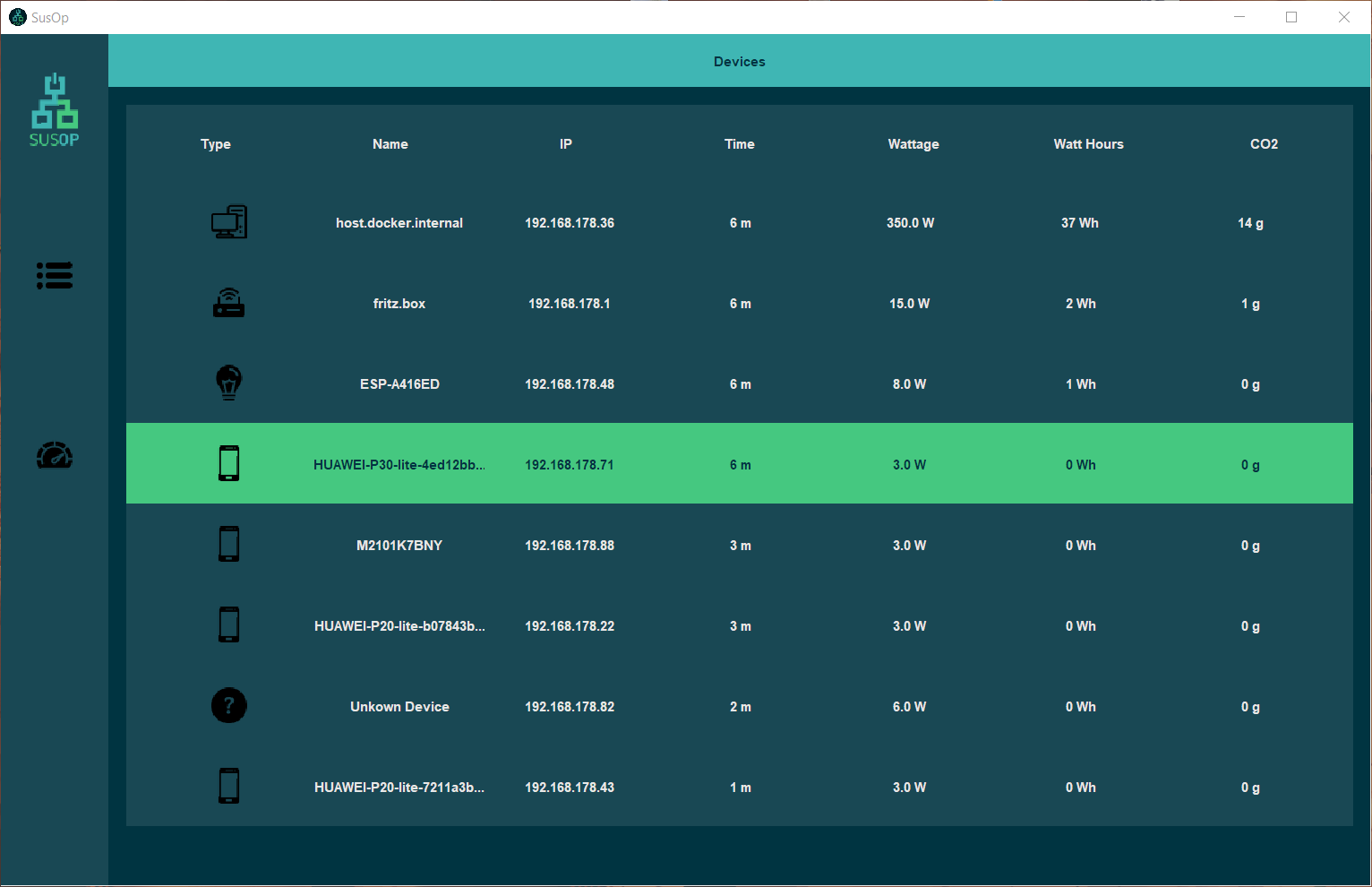
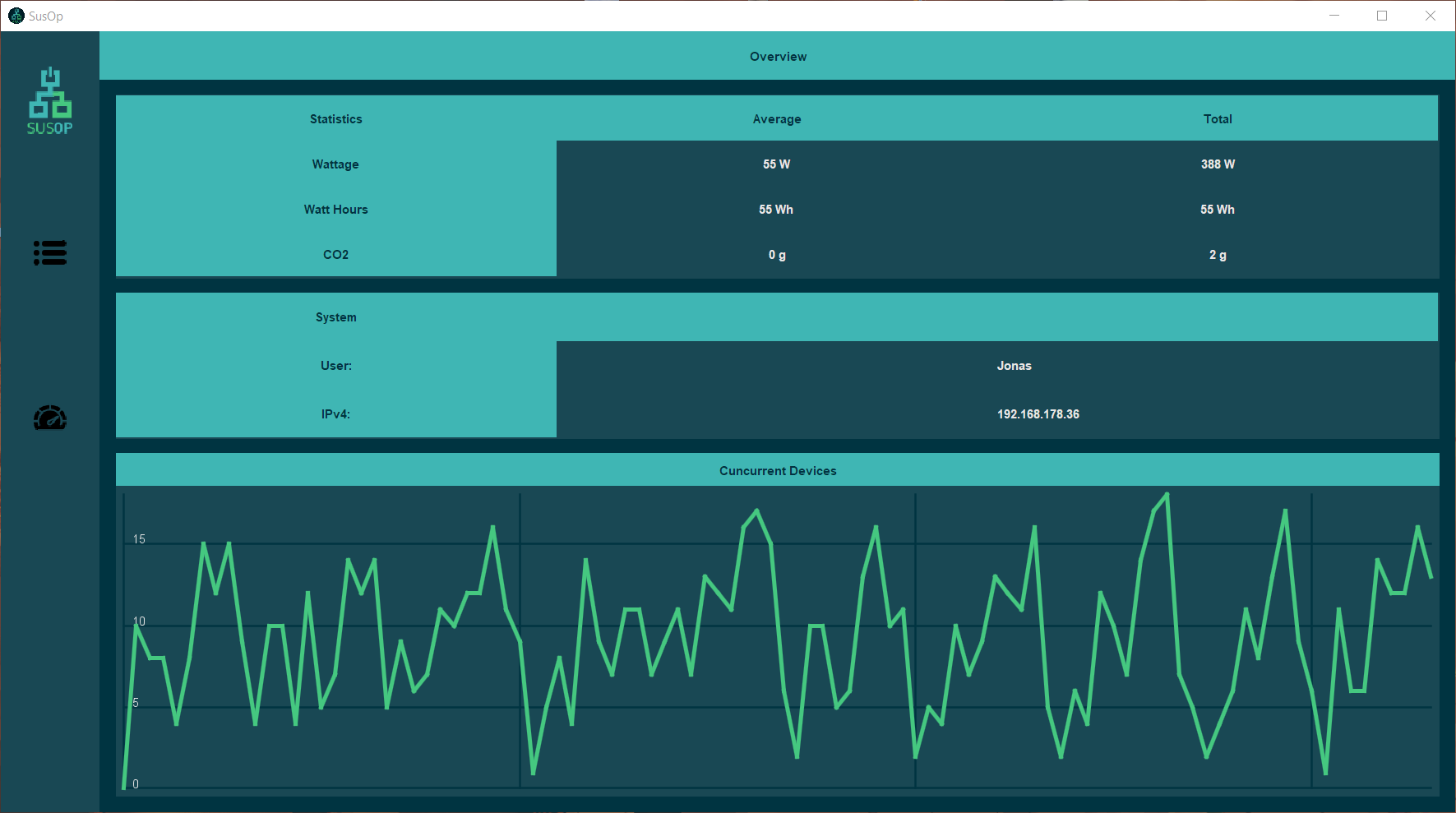
It is a climate conscious network monitor, which keeps track of the CO2 produced by the devices running in the LAN. It is a neat little piece of software meant to increase climate change awareness.
My main contributions were in UI/UX and general desktop development, while my buddy handled networking.
Code available on Github.
Click on Screenshots to view
Classical Raytracer
2021
Solo Development
Weekend Project
Graphics Programming
Software Raytracing
Linear Algebra
Java
Read More
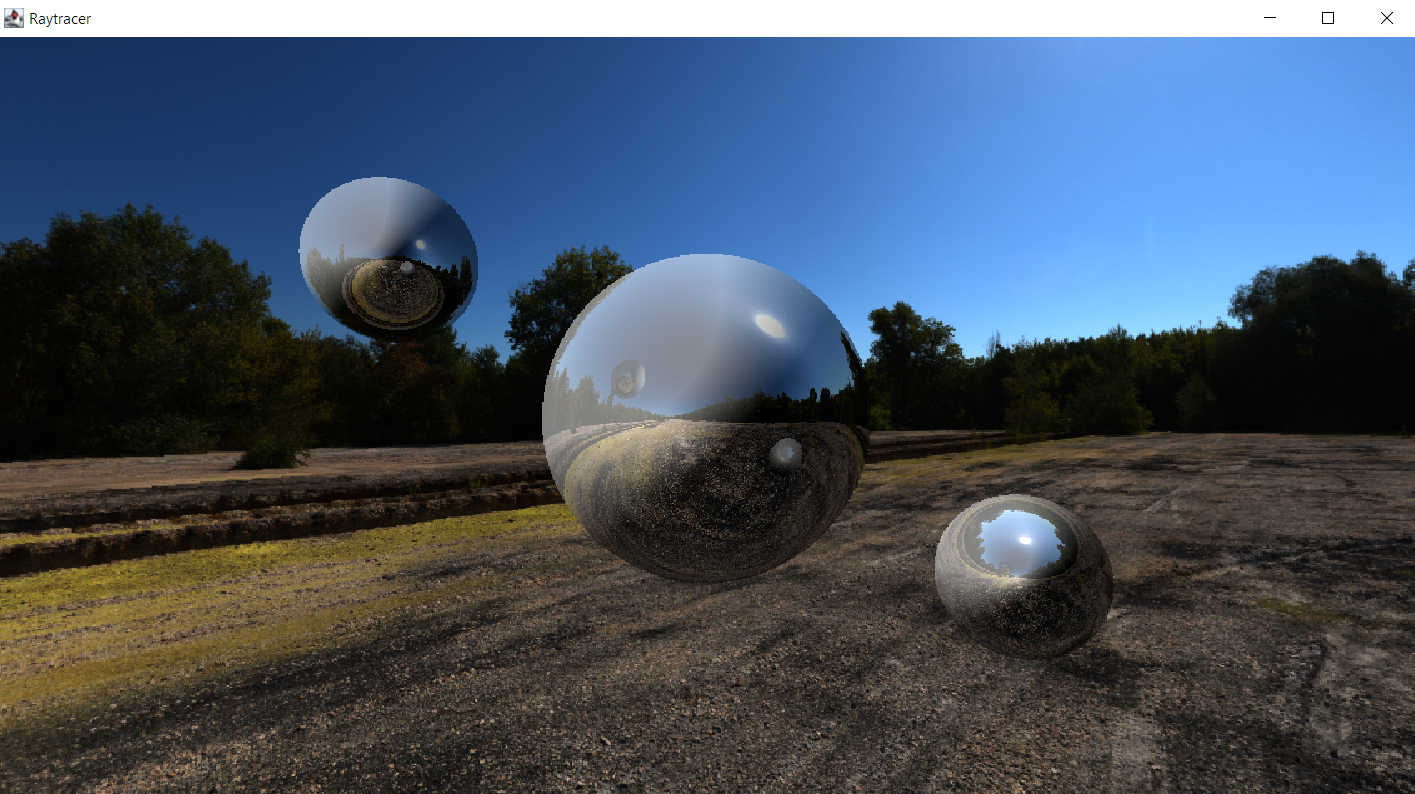
A software raytracer (running on the CPU using Java). It supports multi-threading, spheres, skydomes, planes and phong-lighting.
I made it in order to manually explore the mathematical principles behind the methods that shading languages such as glsl and hlsl provide by default. This experiment serves as an interesting contrast to my latest projects on light simulation.
Click on Screenshot to view